

Bài Tập Thở Và Kỹ Thuật Grounding Giảm Lo Âu: Hướng Dẫn Thực Hành Tại Nhà
If your anxiety spikes at home—tight chest, racing thoughts, doom-scrolling you can’t stop—your nervous system isn’t being “dramatic.” It’s doing its job: scanning for danger. The problem is that modern stress rarely has a clear off-switch.
This guide shows you exactly how to use breathing exercises + grounding techniques to reduce anxiety at home—step by step, with a simple routine you can repeat daily. 🧠🌿
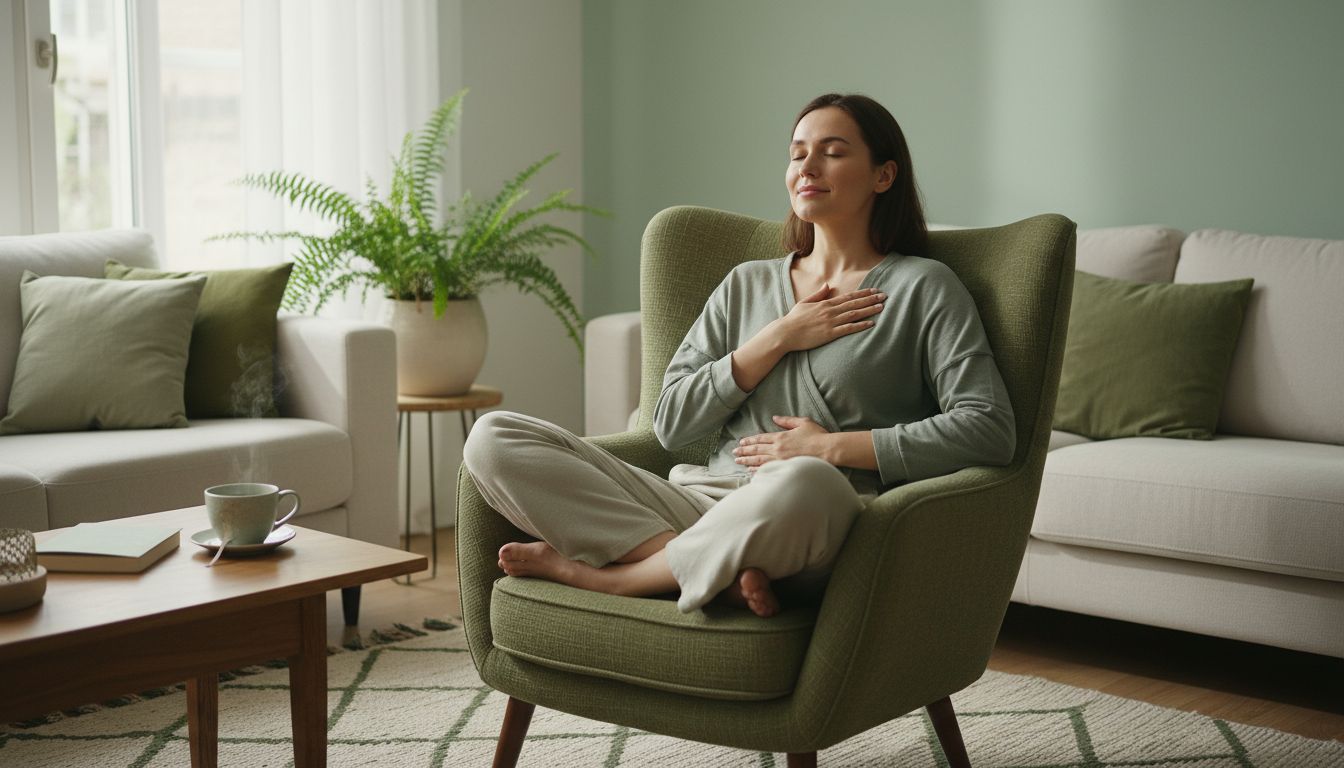
What “breathing + grounding” actually does (in plain English)
Anxiety is often your body stuck in fight/flight. Breathing and grounding work because they change your physiology fast:
- Breathing (especially longer exhales) signals safety to your nervous system and can reduce hyperarousal.
- Grounding pulls your attention from “what if…” thoughts back into here-and-now sensory reality, which reduces rumination.
The takeaway is clear: you’re not trying to “think positive.” You’re trying to send your body a safety cue.
When to use these techniques (and what to expect)
Use them when you notice any of these:
- You’re spiraling in worst-case scenarios
- Your heart rate is up, hands cold/sweaty
- You feel unreal, detached, or “not in your body”
- You’re about to send an impulsive text/email 😬
- You can’t fall asleep because your mind won’t shut up
What you should expect:
- 0–2 minutes: your body may resist (“This isn’t working”). Keep going.
- 3–5 minutes: breath slows, shoulders drop, thoughts lose intensity.
- 10 minutes: you may not feel “amazing,” but you’ll likely feel more manageable—which is the goal.
You’re aiming for downshifting, not perfection.
A quick guided practice you can follow right now 🎧
Read the steps below once, then press play and practice along.
The at-home anxiety reset: do this in order (5–12 minutes)
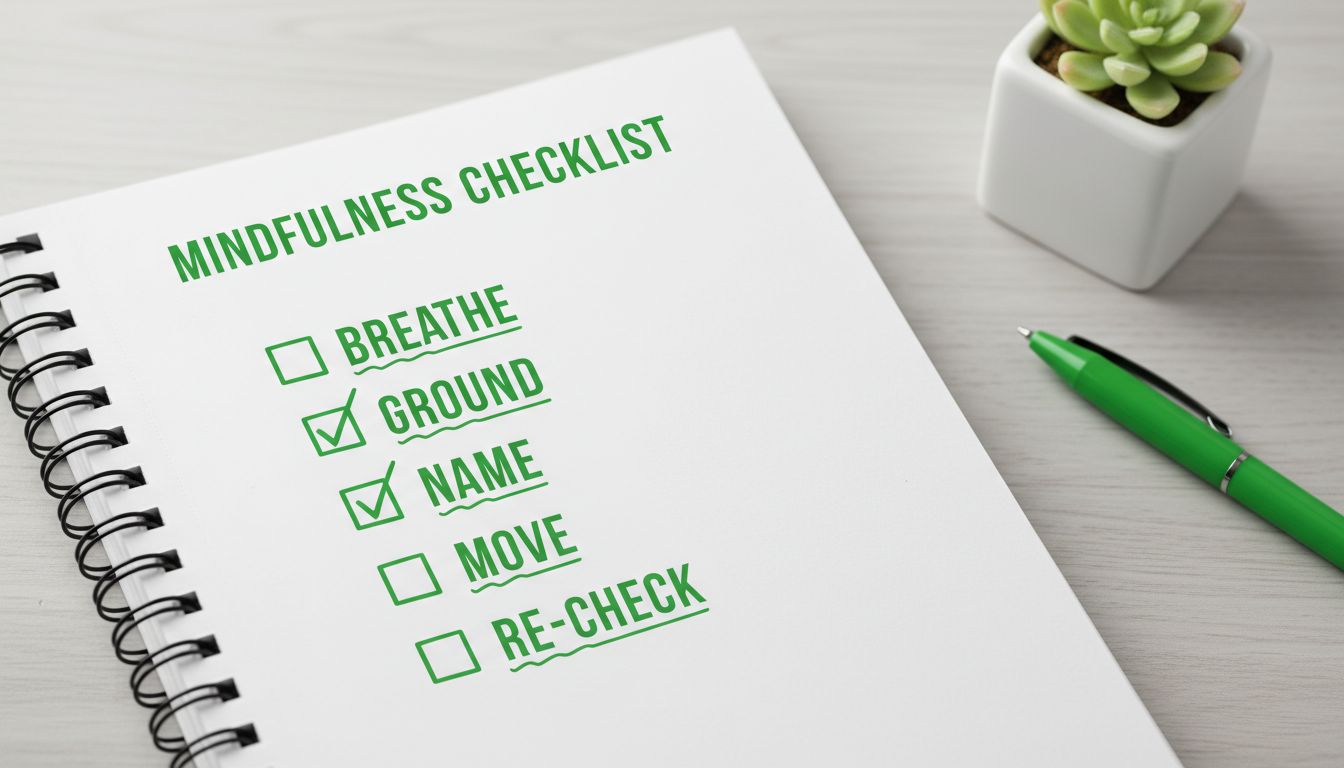
Step 1) Safety setup (30 seconds)
Do this first so your body stops bracing:
- Sit with your back supported or stand with both feet on the floor.
- Unclench your jaw, drop your tongue from the roof of your mouth.
- Exhale once like a sigh (audible is okay). 😮💨
Step 2) Choose one breathing technique (2–5 minutes)
Don’t stack five methods. Pick one and commit for a few minutes.
Option A: Physiological sigh (fastest “emergency brake”) 🚨
Best for: sudden spikes, panic-y sensations
- Inhale through your nose about 70%.
- Take a second quick inhale on top (small “sip” of air).
- Exhale slowly through the mouth until empty.
- Repeat 3–5 rounds.
What you’ll notice: a rapid downshift in chest tightness and urgency.
Option B: 4–6 breathing (simple and reliable)
Best for: general anxiety, daytime stress
- Inhale through nose for 4.
- Exhale through mouth (or nose) for 6.
- Repeat for 3–5 minutes.
Key detail: Make the exhale longer than the inhale. That’s the point.
Option C: Box breathing (structure for a busy mind) 📦
Best for: when thoughts are loud and you need a “pattern”
- Inhale 4
- Hold 4
- Exhale 4
- Hold 4 Repeat 4 cycles.
If holding makes you edgy, skip holds and do Option B instead.
Step 3) Add grounding (2–5 minutes)

Pick one grounding method below based on what your anxiety feels like.
Grounding Method 1: 5–4–3–2–1 sensory scan (classic, effective)
Best for: racing thoughts, spirals, “I can’t stop thinking” 🌀
Name out loud (or silently):
- 5 things you can see
- 4 things you can feel (fabric, chair, feet in socks)
- 3 things you can hear
- 2 things you can smell
- 1 thing you can taste (or imagine tasting)
Make it concrete. “Wall” beats “life.”
Grounding Method 2: Temperature reset (strong signal to the body)
Best for: intense agitation, feeling overheated, panic sensations
- Hold a cool drink can against your cheek.
- Splash cool water on your face or hold a cold pack wrapped in cloth.
- Keep breathing slowly for 60–90 seconds.
Your body responds to temperature faster than it responds to logic.
Grounding Method 3: Orienting (tell your brain where you are)
Best for: derealization, dissociation, “I don’t feel here” 😵💫
- Slowly turn your head and visually scan the room.
- Name: where you are, what day it is, what time range it is.
- Say: “Right now, I’m in ____. I’m safe enough in this moment.”
Yes, it can feel awkward. Still works.
Step 4) Put language on it (30–60 seconds)
This step reduces fear-of-fear.
Complete one sentence:
- “I’m noticing anxiety in my body as ____.”
- “My mind is telling me the story that ____.”
- “This feels urgent, but I can take one small step: ____.”
You’re not debating the fear. You’re labeling it.
Step 5) Re-check your intensity (10 seconds)
Rate anxiety 0–10 before and after.
If you went from 8 → 6, that’s a win. If you went from 6 → 4, even better. ✅
If it didn’t change, don’t panic—switch strategies (you’ll see how below).
Choose the right technique for the right anxiety (quick match table)
When anxiety hits, decision fatigue is real. Use this table and move. 🧭
| What you’re feeling | What’s likely happening | Start with | Then add |
|---|---|---|---|
| Chest tight, panicky surge | High arousal / sympathetic spike | Physiological sigh (3–5 rounds) | Temperature reset (60–90s) |
| Racing thoughts, catastrophizing | Cognitive spiral + body tension | 4–6 breathing (3–5 min) | 5–4–3–2–1 scan |
| Numb, spaced out, “not real” | Dissociation / shutdown | Orienting scan (2 min) | Gentle movement + named sensations |
| Irritable, restless, can’t sit | Excess activation needs discharge | 4–6 breathing (2 min) | Walk + feel feet + describe environment |
| Bedtime anxiety | Anticipatory worry + habit loop | 4–6 breathing (5 min) | 5–4–3–2–1 + journaling prompt |
The 7-minute daily routine (so you don’t only use this “in emergencies”)
If you wait until anxiety is a 9/10, everything feels harder. This daily routine builds baseline regulation.
- 1 minute: physiological sigh (3 rounds)
- 3 minutes: 4–6 breathing
- 2 minutes: 5–4–3–2–1 scan
- 1 minute: write one line: “Today I need ____.”
Want a structured mental-health routine around sleep, food, movement, and boundaries? Read how to build a mental self-care routine for busy people.
Troubleshooting: why it “doesn’t work” (and what to do instead)
Problem 1: “Breathing makes me more anxious”
This is common—especially if you’re hyperfocused on sensations.
Do this instead:
- Switch to grounding first (5–4–3–2–1).
- Use shorter inhale and softer effort.
- Breathe through the nose if possible, but don’t force it.
Problem 2: “My thoughts keep coming back”
Of course they do. The goal isn’t zero thoughts—it’s lower intensity.
Try:
- Add a counting anchor (exhale: “one…two…”).
- Speak grounding labels out loud: “chair, floor, lamp.”
Problem 3: “I can’t stay consistent”
Let’s be honest: motivation is unreliable.
Fix it with friction removal:
- Tie it to an existing habit: after brushing teeth or before coffee.
- Set a 7-minute timer and stop when it ends (no negotiating).
- Track with a simple checkbox calendar.
If burnout is part of the picture, you’ll want a recovery plan too. Use the 7-day burnout recovery plan alongside these techniques.
Add journaling to grounding (when anxiety is “sticky”) 📝
Sometimes anxiety is less about a momentary spike and more about unresolved emotional load. Pair grounding with a short journal prompt:
- “What am I afraid will happen?”
- “What evidence do I have—and what evidence do I not have?”
- “If my best friend felt this, what would I say to them?”
- “What’s one kind action I can take in the next 10 minutes?”
For a full structure, prompts, and a 30-day plan, use the 30-day therapeutic journaling guide.
A realistic safety checklist (when to get professional support)
Breathing and grounding are powerful—but they’re not a substitute for care when things are serious.
Consider professional support if:
- Anxiety interferes with work, school, or relationships most days
- You’re having frequent panic attacks
- You avoid more and more situations to prevent anxiety
- You’re using alcohol/other substances to “turn off” your mind
- You feel hopeless, unsafe, or like you might harm yourself
If you want guided support tailored to your situation, explore Ngọc Tĩnh - Hỗ Trợ Tâm Lý services or contact Ngọc Tĩnh - Hỗ Trợ Tâm Lý to discuss next steps.
Your mini action plan (save this)
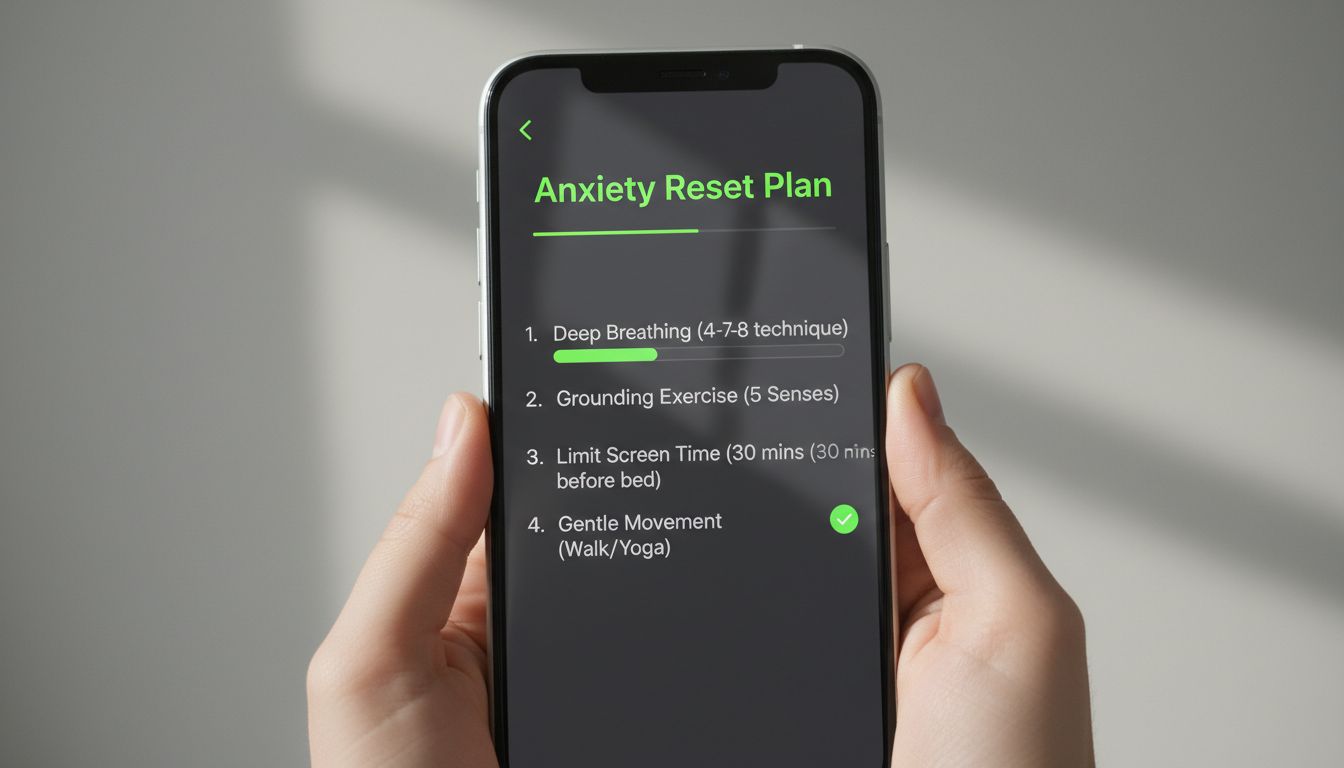
When anxiety hits today, do this:
- Exhale once (drop shoulders) 😮💨
- Physiological sigh x 3
- 5–4–3–2–1 grounding
- Say: “This is anxiety. It will pass.”
- Take one small next step (water, short walk, message a friend, start a simple task)
Consistency beats intensity. A calm nervous system is built in reps.