

Cách Xây Dựng Thói Quen Tự Chăm Sóc Tinh Thần Cho Người Bận Rộn: Ngủ, Ăn, Vận Động, Ranh Giới
You’re busy. You’re juggling work, family, errands, messages, and that never-ending mental checklist. And yet your brain still expects you to be calm, focused, and emotionally steady all the time. Let’s be honest—that’s not sustainable.
The good news: you don’t need a 90-minute morning routine or a wellness retreat to feel better. You need a system—simple, repeatable habits that protect your mental health through four foundations: sleep, food, movement, and boundaries. 🧠✨

What “mental self-care” actually means (for busy people)
Self-care isn’t bubble baths. It’s maintenance—the basic inputs your nervous system needs to stay regulated.
When you’re overloaded, your brain shifts into survival mode:
- shorter temper
- more anxiety loops
- less motivation
- more scrolling, snacking, procrastinating
- worse sleep (which makes everything worse)
The takeaway is clear: your habits either stabilize you—or drain you.
If you’ve been wondering whether you’re “just stressed” or something deeper is happening, it’s worth reading this guide on stress vs. depression and how to tell the difference. It can help you choose the right next step.
A simple framework: build habits that require low time and low willpower
You don’t need more motivation. You need smaller defaults.
Here’s the rule I recommend:
Start with habits that take 2–10 minutes, then scale only after they feel automatic. ✅
The 4 pillars (your mental health “minimum viable routine”)
| Pillar | What it supports | Smallest effective habit | Best time to do it |
|---|---|---|---|
| Sleep 😴 | emotional regulation, focus, stress tolerance | consistent wake time | morning |
| Food 🥗 | mood stability, energy, cravings | protein + fiber at first meal | breakfast/lunch |
| Movement 🚶 | anxiety reduction, resilience, better sleep | 10-minute walk | midday |
| Boundaries 🧱 | burnout prevention, self-respect, clarity | 1 clear “no” per week | whenever needed |
Pillar 1: Sleep — the highest ROI mental health habit 😴
Sleep is the big one. When sleep is off, your brain becomes more reactive and less rational. Even “good coping skills” feel useless when you’re exhausted.

What to aim for (realistically)
- Consistent wake time (even on weekends, within ~60 minutes)
- A wind-down you can actually do, not a fantasy routine
- Less “revenge bedtime procrastination” (scrolling because your day wasn’t yours)
The busy-person sleep plan (choose 2)
- Anchor your wake time: pick a realistic time and keep it 5–6 days/week.
- The 10-minute shutdown: write tomorrow’s top 3 tasks + one worry you’re carrying. Close the notebook. Done.
- Caffeine cutoff: set a time (like 2pm). Non-negotiable.
- Phone parking spot: charge your phone outside the bedroom or across the room.
- Micro wind-down: 3 minutes of slow breathing + wash face + lights dimmed.
If you only do one thing: wake up at the same time. It stabilizes your whole circadian rhythm faster than you think.
Quick “sleep troubleshooting” table
| Problem | Likely cause | Fastest fix to try tonight |
|---|---|---|
| You can’t fall asleep | overstimulation + racing thoughts | paper brain-dump for 5 minutes |
| You wake up at 3am | stress + inconsistent schedule | consistent wake time + earlier wind-down |
| You sleep but feel tired | low-quality sleep, late caffeine, late meals | caffeine cutoff + lighter dinner |
Pillar 2: Food — eat to stabilize mood (not to be “perfect”) 🥗
When you’re busy, meals get chaotic. Skipped breakfast → afternoon crash → sugar/caffeine → irritability → poor sleep. It’s a loop.

Your mental-health plate (simple version)
Aim for:
- Protein (keeps mood and appetite steady)
- Fiber (stabilizes blood sugar)
- Hydration (dehydration looks like fatigue and anxiety)
The “busy day” eating strategy (no tracking required)
Pick one track:
Track A: The 1 meal upgrade
- Upgrade your first solid meal of the day:add eggs/Greek yogurt/tofu/chicken/beansadd fruit or a veggieadd water
Track B: The emergency menu (pre-decide) Have 3 default meals you can repeat with zero thinking:
- rotisserie chicken + bagged salad + rice
- tuna/bean salad wrap + fruit
- tofu stir-fry kit + microwavable grains
A friction-killer: build “food boundaries”
- No meetings through lunch twice a week
- Keep 2 shelf-stable backups (nuts + protein bar, instant oats, soup)
Pillar 3: Movement — the anti-anxiety lever you can pull fast 🚶♀️
You don’t need intense workouts. You need nervous system movement—something that signals safety and discharges stress.

This video is a helpful companion if you want a guided reset mindset while you’re building these habits:
Minimum effective movement (pick one)
- 10-minute walk after lunch (best for mood + digestion)
- 5-minute stretch between meetings
- Stairs for 3 minutes
- 1 song dance break 💃 (yes, it counts)
Make movement automatic with “if-then” planning
- If you finish lunch, then you walk for 10 minutes.
- If you end a Zoom call, then you stand and stretch for 60 seconds.
- If you feel anxious, then you do 10 slow breaths while walking.
Busy people don’t fail because they “lack discipline.” They fail because the habit has too many steps.
Pillar 4: Boundaries — the habit that prevents burnout 🧱
If you don’t set boundaries, your schedule becomes a donation box. And mental self-care won’t “work” because the drain stays open.
The 3 boundary types you need (with scripts)
| Boundary type | What it protects | Example script you can use |
|---|---|---|
| Time boundary ⏳ | recovery + deep work | “I can do 20 minutes today or 60 minutes tomorrow—what do you prefer?” |
| Emotional boundary 🧠 | mental bandwidth | “I care about this, and I can’t process it right now. Can we talk later?” |
| Digital boundary 📵 | attention + sleep | “I’m offline after 8pm. If it’s urgent, call.” |
Two high-impact boundaries for busy professionals
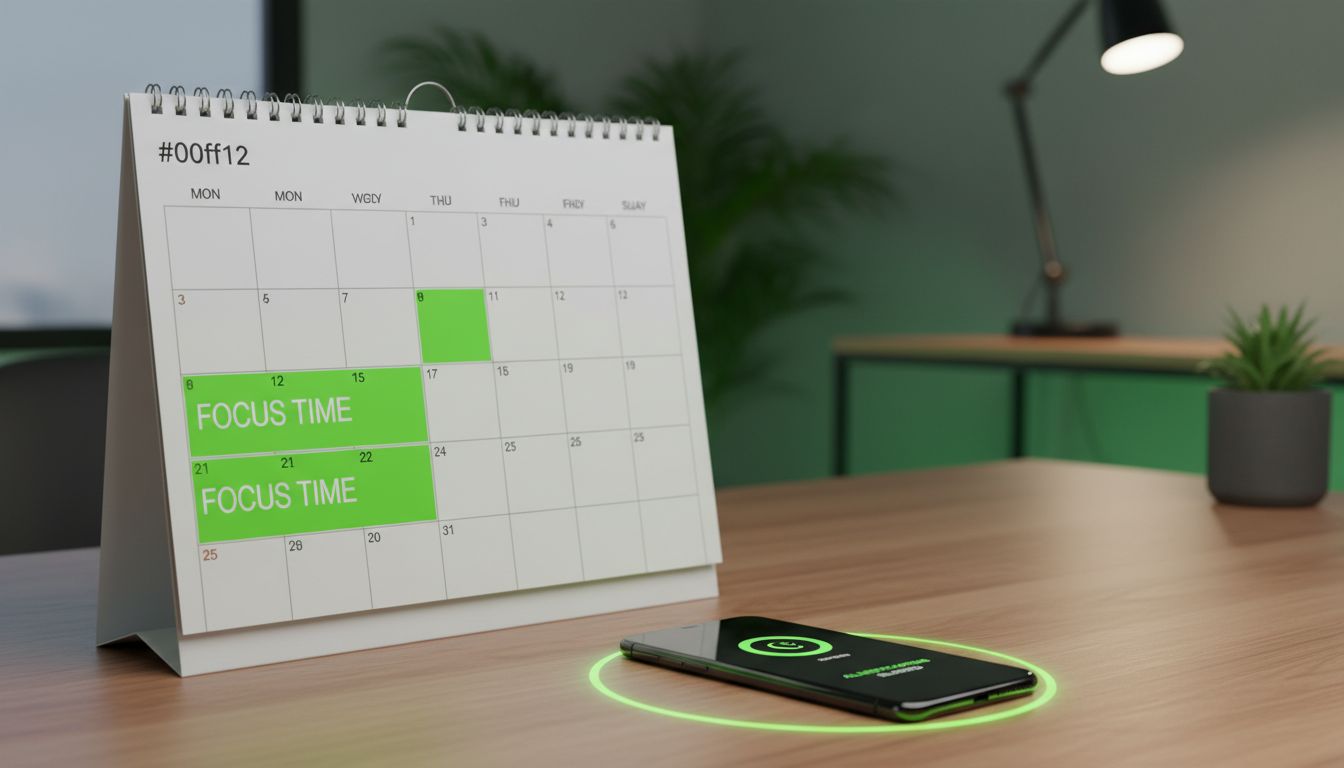
- No-notification windows: 2 blocks/day (even 25 minutes each) where your phone is on silent.
- A hard stop time: choose a “work ends” time 2–3 days/week and protect it.
If you suspect you’re already in burnout territory, don’t guess—use a structured approach like this 7-day burnout recovery plan.
Put it together: a realistic weekly routine (for people who have no time)
You’re not building a perfect lifestyle. You’re building defaults.
The “4×10” plan (40 minutes a day total, broken up)
| Habit | Time | When |
|---|---|---|
| Wake time consistent | 0 extra | morning |
| Protein + fiber first meal | 0–5 min extra | breakfast/lunch |
| Walk or stretch | 10 min | midday |
| Wind-down + phone parking | 10 min | night |
| Boundary action (tiny) | 2 min | anytime |
Weekly checklist (keep it simple)
- ✅ 3 days: 10-minute walk
- ✅ 4 days: caffeine cutoff
- ✅ 2 days: protected lunch
- ✅ 1 time: say “no” or renegotiate a request
- ✅ 5 nights: 10-minute shutdown routine
A “busy brain” self-check: are you coping or slipping?
Use this quick scorecard. If you check 5+ consistently, your system needs support (not more hustle).
| Sign | Yes/No |
|---|---|
| You feel tired even after sleep | |
| Small things trigger big reactions | |
| You procrastinate on simple tasks | |
| You dread messages and notifications | |
| You can’t focus without caffeine | |
| You numb out with scrolling at night | |
| Your body feels tense most days | |
| You feel “behind” no matter what |
If you’re noticing persistent low mood, hopelessness, or loss of interest, this article can help you orient: signs of depression in adults and a starting self-check.
Common mistakes that keep self-care from sticking (and what to do instead)
Mistake 1: You try to change everything Monday
Do this instead: choose one pillar for 7 days.
Mistake 2: You depend on motivation
Do this instead: reduce steps:
- put walking shoes by the door
- pre-decide 3 meals
- set a recurring bedtime alarm
Mistake 3: You treat boundaries like conflict
Do this instead: treat boundaries like clarity. Clear is kind.
When self-care isn’t enough (and that’s okay)
Sometimes you’re not “bad at routines.” You’re carrying:
- chronic stress
- unresolved grief
- anxiety patterns
- depressive symptoms
- relationship pressure
- perfectionism that never turns off
In those cases, habits help—but support accelerates change.
If you want a guided, human approach, explore Ngọc Tĩnh - Hỗ Trợ Tâm Lý services to see how “Đồng Hành Cùng Tiên” can support you.
Your 10-minute start (do this today) ✅
Pick one option:
- Set a caffeine cutoff time (write it down).
- Take a 10-minute walk after your next meal.
- Park your phone 30 minutes before bed.
- Send one boundary message you’ve been avoiding.
That’s it. Small, repeatable, boring. And shockingly effective. 🌿